Why Sydney Couples Are Choosing Therapy Before the Crisis Hits

Love in the Fast Lane: Why Sydney Couples Are Choosing Therapy Before the Crisis Hits

The New Approach to Relationship Maintenance

In the past year, I’ve noticed a shift in my practice at Armchair Psychology. Couples are arriving with a different energy. Instead of sitting across from each other like adversaries in a courtroom, they’re coming in as teammates looking to strengthen their game.

These aren’t couples on the brink of separation. They’re the ones juggling demanding careers in the CBD, managing investment properties, and trying to maintain some semblance of work-life balance. They’re proactive about their physical health, their finances, and now, their relationships.

“We just want to make sure we’re doing this right,” one Woollahra couple told me recently. They’d been together for three years and were thinking about moving in together. Rather than hoping for the best, they wanted tools for navigating the inevitable challenges ahead.

Why the Eastern Suburbs Pressure Cooker Matters

Living in Sydney’s Eastern Suburbs comes with its own set of relationship stressors. Property prices that make your eyes water, commutes that eat into family time, and social circles where everyone seems to have it perfectly figured out.[8][9]

These pressures don’t disappear when you walk through your front door. If anything, they follow you home and settle into your conversations about weekend plans and grocery bills. The couples I work with often describe feeling like they’re performing their relationship rather than living it.

One client described it perfectly: “We’re both successful people who tackle problems head-on in our careers, so why wouldn’t we do the same for our relationship?”.

The Science Behind Getting Ahead of Problems

Here’s what the research shows us: couples therapy has a 70-90% success rate when both partners are committed to the process. But here’s the kicker, those success rates are even higher when couples start therapy before major problems develop.

Think of it like this. You wouldn’t wait until your car breaks down on the M1 to get it serviced. You maintain it regularly to prevent bigger issues. Relationships work the same way.

When couples come to therapy early, we’re not in crisis management mode. Instead, we can focus on building communication skills, understanding each other’s attachment styles, and creating strategies for handling stress together.

What This Looks Like in Practice

The couples choosing preventative therapy aren’t dealing with infidelity or major betrayals. They’re working on things like:

  • Learning to argue constructively instead of shutting down or escalating
  • Balancing career ambitions with relationship priorities
  • Managing different approaches to money and future planning
  • Navigating extended family dynamics and social expectations
  • Creating rituals of connection despite busy schedules

These might sound like small issues, but they’re the building blocks of relationship satisfaction

Breaking the “Soldier On” Mentality

Australians have this tendency to “soldier on” until things are really bad. We see this in how we approach mental health, physical health, and yes, relationships. But the couples getting ahead of the curve understand that asking for help is actually a sign of strength, not weakness.

One partner recently told me, “We figured if we’re going to invest in a mortgage together, we should probably invest in learning how to communicate about it first.” Smart thinking

The Investment That Pays Dividends

When couples develop strong communication patterns early, they create a foundation that serves them through all of life’s challenges. Job changes, family illnesses, financial stress, parenting decisions – these life events don’t disappear, but couples with solid skills navigate them more successfully.

The Eastern Suburbs couples I work with often tell me that therapy has become their monthly relationship check-in. It’s their space to recalibrate, address small issues before they become big ones, and celebrate what’s working well.

If you’re reading this and thinking about your own relationship, ask yourself: are you maintaining your connection with the same intentionality you bring to other important areas of your life? If not, maybe it’s time to get proactive.

After all, the best time to strengthen your relationship isn’t when it’s falling apart. It’s when you have the energy and goodwill to build something even better together.

source https://armchairpsychology.com.au/why-sydney-couples-are-choosing-therapy-before-the-crisis-hits/

When Success Becomes Suffering: Understanding Senior Executive Burnout and Workplace Stress

When Success Becomes Suffering: Understanding Senior Executive Burnout and Workplace Stress

It’s 11.02PM and Sarah’s phone buzzes again. Another “urgent” email from her team leader in London. She’s been the Chief Operations Officer at a major Eastern Suburbs firm for three years, and lately, the late-night calls have become her new normal. She tells herself she’s just being dedicated. She knows this will be another late night – and tomorrow’s commitments begin very early.

What she doesn’t realize is that she’s drowning.

Sarah isn’t alone. In my practice here at Armchair Psychology in Edgecliff, I see more and more senior executives walking through our doors with the same hollow look in their eyes. They’re successful by every external measure, but inside they’re falling apart.

Why Senior Executives Face Unique Mental Health Challenges

Let’s be honest about something most leadership development programs won’t tell you: the higher you climb, the more isolated you become. Senior executives carry burdens that most people simply can’t understand.

Think about it. When you’re responsible for hundreds of jobs, making decisions that affect entire families, and carrying the weight of quarterly results, where do you turn when you’re struggling? Your board expects strength. Your team needs confidence. Your family wants you – present.

But here’s what I’ve learned from working with countless Sydney executives: vulnerability isn’t weakness. It’s actually the foundation of authentic leadership.

The statistics tell a sobering story. Research shows that 61% of Australian workers experience burnout, but for senior executives, that number jumps even higher. We’re seeing 80% of senior leaders reporting exhaustion levels typical of burnout risk. That’s not just a personal crisis; it’s an organizational emergency.

The Difference Between Stress and Burnout

Many of my clients say things like “I’m just stressed, everyone gets stressed.” But there’s a crucial difference between healthy stress and destructive burnout that too many leaders ignore until it’s almost too late.

Stress is your body’s natural response to challenges. It can actually motivate you and sharpen your focus. Burnout, on the other hand, is what happens when chronic stress overwhelms your ability to cope. It’s characterized by three key elements: emotional exhaustion, cynicism or just negativity about your work or your colleagues, and a sense that you’re ineffective despite working harder than ever.

Physical symptoms include chronic fatigue that doesn’t improve with rest, frequent headaches, disrupted sleep patterns, and a weakened immune system. Emotionally, you might notice increased irritability, feelings of detachment, or a loss of enjoyment in the very work that once excited you.

But here’s what concerns me most as a psychologist: the shame. So many executives believe that admitting they’re struggling somehow disqualifies them from leadership. Nothing could be further from the truth.

Recognizing the Warning Signs

In my years practicing psychology in Sydney’s Eastern Suburbs, I’ve noticed that senior executives often miss the early warning signs because they’re so focused on external performance metrics. Let me share what I watch for:

Are you finding yourself irritated by requests that wouldn’t have bothered you before? Do you feel emotionally numb during meetings that should engage you? Are you struggling to concentrate on complex decisions? These aren’t character flaws; they’re your mind’s way of signaling that something needs to change.

Physical symptoms are equally important. One client recently told me, “I used to bounce out of bed ready to tackle the day. Now I feel tired before I even get up.” That chronic fatigue, combined with frequent illness, headaches, or changes in appetite, often signals that stress has crossed into burnout territory.

The impact ripples beyond the office. Family relationships suffer when work stress follows you home. I often work with couples where one partner’s executive role is creating tension throughout the entire family system. The spouse feels like they’re competing with a job for their partner’s attention, and children sense the chronic tension even when parents try to hide it.

Five Practical Strategies That Actually Work

After years of helping executives reclaim their well-being, I’ve identified strategies that create real, sustainable change. These aren’t generic wellness tips; they’re approaches grounded in psychological research and proven in real-world leadership situations.

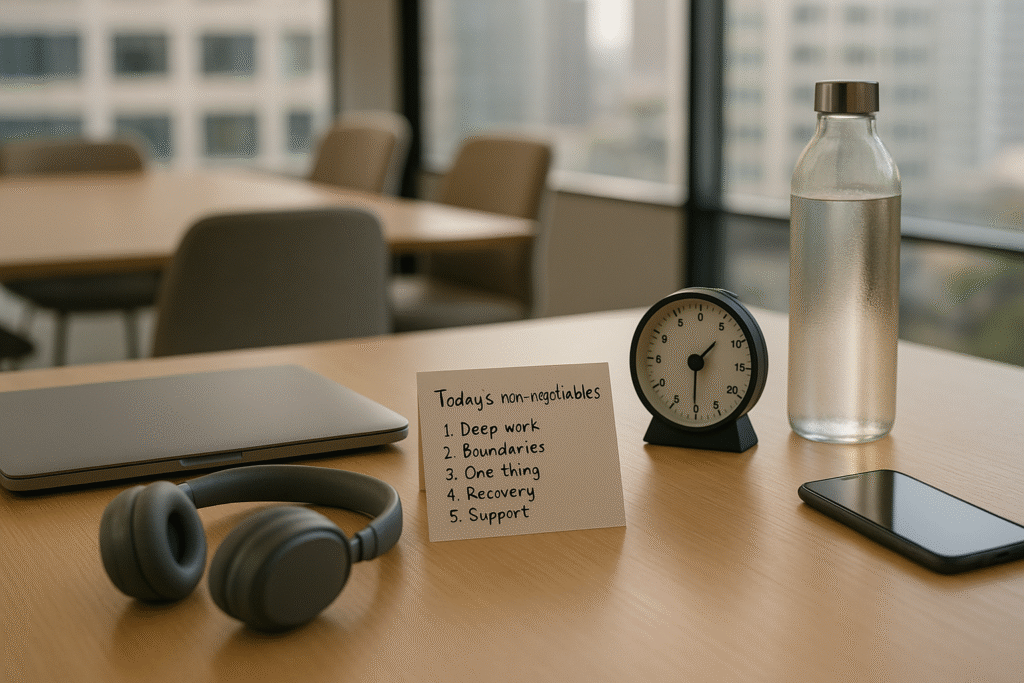
Create Non-Negotiable Boundaries

The most successful executives I work with have learned to say no strategically. This doesn’t mean being unresponsive; it means being intentional about where you invest your energy. Say no based on the bigger picture, not personal preferences. Keep your eye on the whole game by  identifying your three most important priorities each day and protecting them fiercely. Everything else can wait or be delegated.

Develop Your Emotional Intelligence Network

Isolation kills resilience. Build a small circle of trusted advisors who aren’t afraid to tell you the truth about how you’re doing. This might include a mentor, a coach, or even a peer group of other executives. The key is finding people who understand the pressures you face but aren’t financially dependent on you.

Practice Micro-Recovery Techniques

You don’t need week-long vacations to restore your energy. Research shows that brief, intentional breaks throughout the day can be incredibly effective. This might be five minutes of deep breathing between meetings, a short walk around the block, or simply stepping outside to feel sunlight on your face.

Reframe Your Relationship with Control

Many executives burn out because they try to control everything. But here’s a truth that might surprise you: accepting what you can’t control actually increases your influence over what you can. Focus your energy on your responses, your decisions, and your team development rather than trying to manage every variable.

Invest in Professional Support

The strongest leaders I know have learned to seek help before they’re in crisis. Whether that’s working with an executive coach, seeing a psychologist, or joining a leadership support group, getting an external perspective isn’t a luxury – it’s essential maintenance for anyone in a high-pressure role.

The Ripple Effect of Executive Well-being

What many leaders don’t realize is how profoundly their well-being affects everyone around them. When you’re operating from a place of chronic stress, your team feels it. Your decision-making suffers. Your creativity diminishes.

When you prioritize your own mental health, something remarkable happens. You become more present with your team. Your strategic thinking improves. You model healthy behaviors that give others permission to take care of themselves too.

I’ve seen this transformation countless times in my practice. Executives who address their burnout don’t just feel better personally; they become better leaders. Their teams report higher job satisfaction. Their family relationships improve. Their companies perform better because they’re making decisions from a place of clarity rather than exhaustion.

Taking the First Step

If you’re reading this and recognizing yourself in these descriptions, you’re already ahead of many executives who don’t understand what is happening to them. Acknowledging that you might need support isn’t a sign of weakness; it’s an act of courage and wisdom.

At Armchair Psychology, we understand the unique pressures facing senior executives in Sydney. We know how difficult it can be to find time for self-care when everyone needs something from you. That’s why we offer flexible scheduling and complete confidentiality. No referrals are needed, though Medicare rebates may apply with a GP referral, or your private health cover may contribute to the cost.

The executives who thrive in today’s demanding business environment aren’t the ones who never struggle; they’re the ones who recognize when they need support and have the courage to seek it. Your leadership, your family, and your own well-being are too important to leave to chance.

Ready to reclaim your well-being and become the leader you’re meant to be? Contact Armchair Psychology at our Edgecliff practice. We’re here to help you develop the practical skills you need to manage stress, prevent burnout, and lead with authenticity. Call us today or visit our website to schedule your initial consultation. Your future self will thank you.

source https://armchairpsychology.com.au/when-success-becomes-suffering-understanding-senior-executive-burnout-and-workplace-stress/

How Aussie workers are silently struggling revealed

There is stress in the Australian workplace. I was recently interviewed as part of a Herald Sun piece titled ‘Alarming trend: How Aussie workers are silently struggling revealed.’

Here is a brief excerpt:

Australians are “quietly cracking’’ at work, as cost-of-living stress and other pressures continue to take their toll.

Experts warn the alarming trend, whereby Aussies put on a brave face at work to mask their struggles, is a ticking time bomb, with those affected six times more likely to suffer burnout.

Research reveals more than half the Australian workforce is quietly cracking, mostly due to stress related to housing costs and rising bills.

Follow the link above to learn more.

If this story feels all too familiar, don’t hesitate to reach out to our team by calling us on 1300 765 125.

source https://armchairpsychology.com.au/aussie-workers-silently-struggling-research-oct-2025/

Becoming an accredited cool kids provider

Psychologists have a requirement to undertake Continuing Professional Education. This can be attendance at courses or seminars, or completing other activities which contribute to continued learning. As Psychology is an ever-evolving field in a phase of huge discovery, it is especially important for clients that we as Psychologist keep up to date on best practice.

It was with that in mind that I recently decided to learn more about the a program called Cool Kids. The Centre for Emotional Health is a Macquarie University initiative, which researches and treats emotional disorders such as anxiety and depression, through their Clinic. Over more than 20 years of research, they have developed a treatment program for anxiety, called Cool Kids.

Cool Kids is what’s called a manualised treatment program, and is based on cognitive behavioural therapy strategies. This means that if a child has symptoms that are consistent with anxiety, they will be taught specific strategies, in a way that have been proven to be effective at helping people reduce their anxiety. Cool Kids can be undertaken as either part of a group of kids, or one-on-one. On the outcomes of treatment, the Centre for Emotional Health state “following treatment, there are marked increases in school attendance, academic achievement, confidence, number of friends and involvement in extra-curricular activities and decreases in worry, shyness, fear and family distress.” This means that for the majority of kids who undertake Cool Kids, they will experience less anxiety, and enjoy their life more.

To provide some specificity to particular age groups and presentations, there are a few different version of the Cool Kids program:

  • Cool Little Kids
  • Cool Kids Anxiety Program
  • Cool Kids ASD Anxiety Program
  • Cool Kids (Chilled) Adolescent Anxiety Program
  • Cool Kids (Chilled) Adolescent Anxiety and Depression Program

I was confident that Cool Kids was a service I wanted to be able to offer my young clients and their parents. As I had learned that the program(s) could only be delivered by accredited providers, I set about doing the Cool Kids training program, so that I could become one. After learning about the Cool Kids-specific way of addressing anxious thoughts and behaviours, and showing that I understood the theory and techniques involved, I’m happy to be able to offer the Cool Kids suite of programs.

.

source https://armchairpsychology.com.au/childrens-therapy-child-psychologist-sydney/

Working as a team to increase cohesiveness

In my time working at Armchair Psychology, it has become evident to me that each of the Psychologist team members have varied and valuable skill sets.  No one person can claim to know everything about everything, so it is helpful for me to know that wherever I might be stuck on something, or not sure how to best help a client, that there is another Psychologist available to lend an ear and share their knowledge with me.

We have found our weekly team meetings to be a supportive space in which we can share what we’re stuck on.  We always make sure we de-identify any information, so that we honour our commitment to client confidentiality.  We tend to talk about themes, psychological techniques, or other specific services, and not information about a client’s life that would compromise confidentiality or respect.  Psychologists have an obligation to ensure that we attend “supervision” with other Psychologists to keep up to date on best practice, and continue our learning.  Given the benefit of talking through things with my colleagues, I am reminded of the importance and requirement of doing this to maintain registration as Psychologists.

We also find that the team meetings are a space where we can feel safe and valued in sharing our knowledge where appropriate.  This process of give and take helps us develop our psychological skill sets, and feel part of a friendly, supportive, knowledgeable team.

If you would like some helpful tips and feel like it is lacking in your workplace and would like support, reach out!

.

source https://armchairpsychology.com.au/working-as-a-team/

Our project on grief

The psychology team at Armchair Psychology Practice talk a lot about the issues that affect our clients. The one that is overwhelmingly at play is grief – in all its forms.  Whether there has been a death of a loved one, or someone we love is dying; whether chronic illness or disability has changed the way life will be; whether a relationship is ending or has come to an end – even children going through life’s stages and moving away from parents – grief is a natural response.

The foremost thought is always, though, if grief is so common, felt by us all, and is so natural, why do we find it so hard to deal with? Why do we find it so hard to reach out and take comfort, to accept the help offered? And, conversely, how is it possible to see someone grieving and yet walk away?  Our worlds have got too busy, people are too isolated. Psychologists know that the best way to deal with grief is to talk about it, to cry, to shout, to mourn. It is a shame that the common wisdom is that we should “Soldier on”, even when that is the worst thing to do. Grieving is NOT the same as wallowing (and so what if it is, it is necessary!)

The problem with grief is that it makes us stop.  It takes over and insists that we deal with the feelings. Many people try really hard not to allow grief to interfere with their ongoing life tasks.  They think they are being strong when they push them away, or take medication to stop the feelings and allow themselves to sleep. Psychologists know that that just doesn’t work in the longterm.  We might feel better when we avoid the feelings, but grief has a way of catching up with us and forcing us to face our losses.

The people whom we see in our practice are sometimes those who know they need to talk and to be sad, and find ours a safe place to do that.  Often, they are finding it hard to get on with everyday life because they are so sad, and don’t know how to take the time for themselves to grieve. Then there’s the other group – the complicated grief – people suffering emotionally and being so distant from the loss that they sometimes are not even aware of why they feel so terrible. Then our work as psychologists is to carefully, sensitively, help them face the grief of the loss.  Once they reconnect with all the feelings they have pushed down hard, they will discover their tears and then be free to move forward in their lives.

When you allow yourself to mourn, you can keep hold of your loved one in your heart, and continue on in life, being functional and okay.

.

source https://armchairpsychology.com.au/our-project-on-grief/

Life after 50

Yesterday I did one of my favourite things – live radio! I was on SBS Radio, in their Artarmon studios, and responded to listeners’ questions about the range of issues  that challenge us as we get older.  Depression was obviously a common theme – whether it was triggered by downsizing, retirement, missing one’s childhood home and family, facing the death of parents, or the illness of friends. You can listen to the full podcast here: http://www.sbs.com.au/yourlanguage/hebrew/en/content/amanda-gordon-clinical-psychologist-sbs-about-life-after-50-2042017. Don’t worry, it’s all in English!

You can also go to our Armchair Psychology Facebook page, where I have posted the video stream of (most of) the interview – there were a few early technical hitches.  That’s actually part of why I love live radio.  I had to wing it, while Nitza Lowenstein, the presenter of the programme, fixed the recording device. It was distracting, but I could be a “true radio professional” and carry on regardless.

I am always hopeful that, while I respond to specific concerns of individual listeners, I am assisting people change their thinking in their own lives.  That’s why I give general rather that personal responses. Do let me know if any of my words struck true to you, or made a difference to the way you look at things.  You can comment on the Facebook page if yo

.

source https://armchairpsychology.com.au/life-after-50/

Kids & Bullying

With the prevalence of social media, online bullying and trolling has unfortunately become more present than ever. Kids can no longer escape the school yard bullies in the sanctuary of their own homes, with the online world making it easier and more accessible for vulnerable kids to be targeted. For this reason, it is important that we give kids the skills to manage social situations.  These skills include listening to others, communicating their needs without whining, deciding when to put up and shut up, asserting discomfort in a situation (if it occurs) and waiting their turn in a game. They initially learn through engaging with their parents and siblings and extended family, then through family friends.  They then take what they have learned to childcare, preschool, then school and gradually into other social situations. All along the way, it is important that we model appropriate social behaviour, show them when they are not behaving properly (either victimising or being victims, not sharing or tantruming) in social situations.

Just like adults, kids are going to encounter other kids they don’t particularly get along with – and may potentially have issues with. It’s important we teach children skills that they can use to handle and manage difficult situations. We also have to help them build resilience, instead of solving their problems for them. We want them to cope in a world when they won’t always get their way. Listed below are five key tips on building resilience in kids:

  1. Pay attention to them – as parents we must really listen to what our children say to us, when they come to us for advice or just to be an ear and lend support. They are then more likely to really listen to others as well.
  2. Give them real feedback –  rather than telling them ‘things will be okay’, it’s important to be honest and tell them when things are not okay or where they need to improve.
  3. Give them opportunities to have a disagreement with siblings or friends – while our instinct is always to protect our kids, it’s important that we don’t always step in and solve problems for them.
  4. Allow them to be upset – it’s important that kids know their feelings are valid – let them be hurt/upset and then assist them to develop strategies to manage and rectify the situation.
  5. Be a good role model – kids need to see parents showing emotion too and having bad days, that way kids can see parents confronting the hurt and sorting it out.

Why do kids bully?

There are two sides to every equation and it’s crucial that we understand bullying from the other side. So, why do kids bully? Parents are often faced with the question – ‘but why is he/she mean to me’, ‘what did I do’ etc. It’s important for kids to know that in many cases the child who is being targeted has done nothing wrong.  The best thing I have ever taught kids is that “bullies must be pretty unhappy to want to make you unhappy.  Perhaps you could help them connect with their real feelings”.  Most kids don’t want to be bullies and would prefer to have real friendships – but they don’t always know how. Kids more likely to be bullies are those who feel neglected or unappreciated by others, or those with low self-esteem. Sometimes they then want others to feel worse than they do. In addition, kids who always get their own way at home, may expect everyone else to give way to their demands. Kids who have parents who bully them, don’t learn alternative ways to engage with others, and often repeat the pattern in social situations. Listed below are some practical tips for kids dealing with bullying  across different circumstances.

Tips for dealing with bullying for primary school children

  1. Remind them they should seek help from an adult.
  2. Encourage them to play with other friends.
  3. Have non-bullying children over on play-dates
  4. Have the children play in front of the parent, rather than hidden away – parents must model assertive, non-bullying, but not victim behaviour either, when intervening.

For adolescents/high school aged

  1. Make yourself available so they can share their distress.
  2. Encourage a diversity of friends.
  3. Support your child in behaviours that are non-conforming, if that’s what they want.
  4. Ensure the child has good hygiene.
  5. Talk generally about social issues, difficulties you may have had “some people etc …” to give your child a sense of not being alone.
  6. If you are really worried your adolescent is being bullied, talk quietly to teacher/school counsellor/ child’s best friend. Enact safety measures.

How does being bullied affect a child’s mental health and well-being

Now that we’ve looked at bullying from the most significant perspectives, it’s important to understand the burden of bullying upon a child’s mental health and well-being.  Children can exhibit a range of emotional responses.  Some withdraw. Others (especially younger ones) regress. Anxiety may appear, but not necessarily related to social situations. Young children may not want to go to birthday parties; older ones may withdraw from group activities.  Depression is not always identifiable as being anything other than adolescent behaviour, so it’s tough. If your adolescent becomes overly moody, withdrawn, unsociable, it may be worth checking in with their best friend confidentially for confirmation as to whether this is aimed just at the family. In older kids, self-harm and even suicide can be the outcome of bullying.

Parenting is not always easy and we don’t always feel the rewards immediately.  It can be hard to watch our child struggle with difficult social interactions. Sometimes, our children don’t want us to interfere and we have to make judgement calls. The trick is to remind ourselves of our goal of building healthy, happy, effective, independent adults.  Then we can put in the hard work of watching our children struggle and supporting them to make healthy decisions, rather than jumping in quickly.  When we do that, they will not tolerate being bullied, and won’t bully anyone else.  They will feel good in their own skin – and you’ll have been the best you can be as a parent. If you’re looking to speak to someone further, click the link to get in touch.

.

source https://armchairpsychology.com.au/kids-bullying/

How to Survive the holiday season – A Guide

Many people tell me that they would prefer the label “Stressful” to “Silly” for the current season. What can you do to survive it?

There is an urgency in the air. So much to do, so many people to see, so little time – and often, a great reluctance to do it. Buying presents, often for people whom you see rarely of perhaps don’t particularly care for, can put a big hole in your budget. Preparing for a holiday, when these extra tasks are also to be done, can put a big hole in your time. Having to get everything done can lead to irritability – with your partner, workmates, children – and that means shame, it means extra work to mend relationships, and it can mean extra tension when you just need a break.

This is also party season, which carries with it its own dangers. What can you do to survive it?

  1. Continue your normal exercise routine or replace it with something different. Don’t just assume that dancing at parties will be enough. The best protector of mental health is sensible physical exercise.
  2. Alcohol is only your friend when used in moderation. When you drink, you increase your reactivity and irritability, and can really muck up important relationships. Ensure you have alcohol-free days, and that when you are drinking, you intersperse alcoholic drinks with non-alcoholic, so that you quench your thirst sensibly and only sip on your alcohol. This will be of major benefit in helping you survive silly season.
  3. Take time for yourself if you can. Perhaps put away your screen in the evening and instead have a relaxing shower, do some yoga or breathing, sit quietly without stimulation. Or go for a gentle walk.
  4. Keep an eye on your significant relationships and make time for them too. Don’t put them on hold while you spend your time partying or shopping. Do some of it together.
  5. When spending time with difficult family members (often those you have avoided during the year but have to spend time with at Christmas), keep the topic of conversation simple and non-controversial. If you are mindful of what is going on, you can keep things gently on track and avoid minefields. Being sober will help that process.
  6. Sleep helps us manage our emotions. Ensure you have enough. Burning the candle at both ends may not lead you to greater happiness.
  7. Write lists and cross tasks off when they are completed. It will give you a real sense of satisfaction and will also make you more efficient, leaving you more time to enjoy this very silly season.

Have a wonderful festive season and new year!

If you are feeling overwhelmed or anxious at this time of year please get in touch for further support.

.

source https://armchairpsychology.com.au/how-to-survive-the-holiday-season/

Resolutions Or Just Good Intentions? 7 Keys To Achieving Your New Year’s Goals.

New Year is almost always associated with New Year’s Resolutions. Many people wisely use this quieter time of the year to reflect on their lives and consider ways to enhance them in the coming year.  They then resolve to do things differently, or – less wisely – to aim for a particular outcome.

There is much evidence in the psychology literature for the benefits of self-reflection. Many of us don’t stop much during the year to think about life and our place in it, how we are travelling or what we would like our lives to be like.  So we decide to do this in anticipation of the new year.  This custom originated in colder climates, though, where people were forced inside around the fire, and had long dark nights suitable for reflection.  In the Australian summer, many of us make resolutions based on little other than a quick thought that “weight loss would be a good idea”, or “I need to exercise more”, without the consideration as to how those things would change our lives or even whether they are relevant changes to make.

Weighing up what has worked for you and what was problematic in the previous year can assist choices to change behaviour, so as to achieve different outcomes in the coming year. Without that reflection, unachievable goals are set in the guise of resolutions, and by mid-February many good intentions have well and truly come undone. However, if you really do believe, on proper reflection, that there are some things worth changing in your life, then here are seven things you can do to increase the likelihood of making those changes stick:

  1. Ensure that you want to change in the way that you are about to resolve. You not only have to intend to change, you have to be motivated to make the change. That is, you can see some benefits that outweigh the effort you will have to expend to make this change. For example, you may like to lose some weight (the most common resolution made on and off Australian beaches this year). In order to do that, you will definitely have to change the way you eat and the way you exercise or expend energy.  Are you sure you want to do that?? It is all very well to want an outcome, but do you want to put in the work to make the outcome happen.  Making a resolution is not the same as wishing for an outcome.
  2. Ensure that your resolution is about the behaviours or actions you will change, rather than being dependent on other people’s actions.
  3. Ensure that your resolution is worded in a positive way i.e. resolve to do something rather than not do something. For example, resolve to eat a sensible diet rather than resolving to not eat certain fun foods.  Success has to come from what you do, because that is clear.  You can’t rack up a successful day from not eating a biscuit – rather, your day will be successful if you have had a balanced day of eating, even if the biscuit was included in the balance.  Resolutions to exclude things from your life that you enjoy are rarely kept.
  4. Ensure that you word your resolution around measurable changes in behaviour that can be rewarded. For instance, if your resolution is to stop smoking cigarettes, then yo should resolve to do something else specific to your needs, whenever you feel the urge to smoke. As you are successful at behaviour change, reward yourself. For example, a reduction in the number of cigarettes smoked in a week could lead to a reward of the cost of a packet of cigarettes going into a slush fund for a future enjoyable activity.  Then every non-smoked cigarette is given extra credit for the money that is now available for another enjoyable (but healthy) activity. The accrual of funds in that account will help motivate you to find an activity other than smoking when you are stressed or bored.
  5. Tell a friend about your intentions to change your behaviours and even see whether they would be prepared to join you in making those changes. There is good psychological evidence that behaviour change occurs best when people share common goals and work together towards them. Even if you don’t have someone who wants to make the same behaviour change as you do, find yourself a supporter, a coach, a cheerleader, from amongst your acquaintances, who will listen to you when you are finding it difficult and support your efforts, and who will cheer as you have success as you move towards change.
  6. Recognise that you are only resolving to make change because you have been doing things that haven’t worked for you. However, they have become habits, and you will need to work hard to change your behaviours to be more effective in your life.  There will be obstacles – temptations to give up, triggers for your old maladaptive behaviours.  You need to plan for these obstacles and have some ideas about what you will do when you meet them.  For example, if you are resolved to reduce your alcohol intake, recognise what triggers led to excessive drinking in the past (perhaps a bad day at work or an argument with your partner). Assume you will still sometimes have a bad day or an argument and plan other behaviours in response. For instance, after a bad day at work, come home and change, and go out for a brisk walk.  Or phone a friend. Or have a relaxing bath.  Then reward yourself for avoiding that pitfall, by telling a friend or writing it down or just saying “well done” to yourself.
  7. Remember, although the new year may be the time to reflect and make resolutions for the future, it is alright to work up to behaviour change. It is not a failure if you make some changes then revert for a while.  Once you have recognised that you can take charge of your own life and make changes that will work for you, it is practice and hard work that will make the changes the new way of life that will work for you, and help you life a more effective life.

If you are keen to resolve things for 2019 contact Armchair Psychology to see how we assist you define your resolutions and help incorporate real change into your life.

.

source https://armchairpsychology.com.au/7-keys-to-achieving-your-new-year-goals/